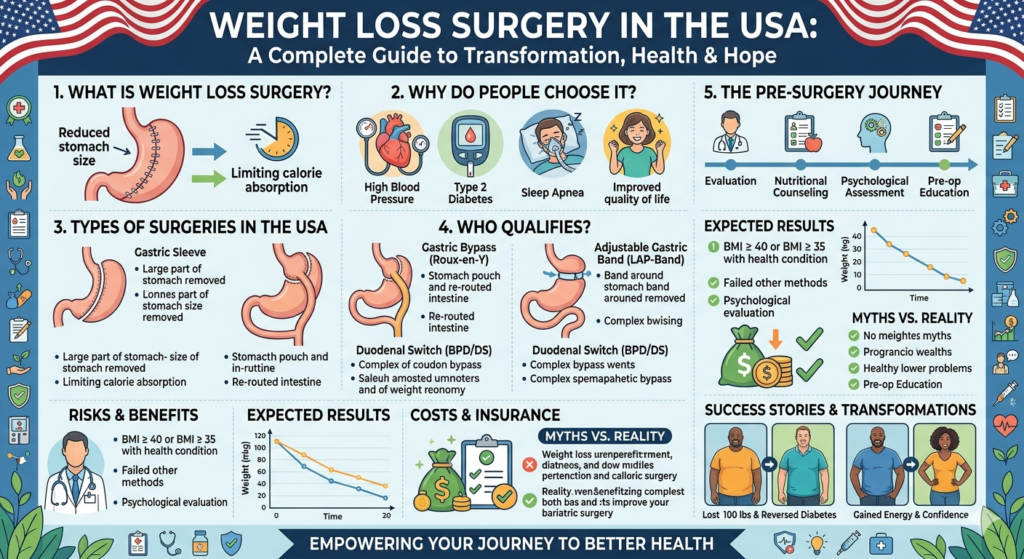
Weight Loss Surgery in the USA: A Complete Guide to Transformation, Health & Hope
Weight loss surgery — also called bariatric surgery — has become one of the most talked‑about medical breakthroughs of the 21st century. For millions of Americans struggling with obesity, chronic health conditions, and emotional distress tied to weight, bariatric surgery represents not just a procedure, but a pathway to renewed health, confidence, and quality of life.
In this in‑depth guide, we’ll explore:
- What weight loss surgery really is
- Why so many people choose it
- The different types of surgeries offered in the USA
- How to qualify & prepare
- Risks and benefits
- Expected results
- Costs, insurance, and accessibility
- New trends & future directions
1. What Is Weight Loss Surgery?
Weight loss surgery refers to medical procedures designed to help people lose significant amounts of weight by altering the digestive system. These surgeries work by either:
- Reducing stomach size (restriction),
- Limiting calorie absorption (malabsorption),
- Changing hormone signaling to reduce hunger and improve satiety,
- Or a combination of the above.
It’s not a cosmetic surgery — it’s a medical intervention for people with serious weight‑related health risks.
2. Why Do People Choose Bariatric Surgery in the USA?
Despite the rise of diet trends, fitness plans, and wellness programs, obesity remains a major health issue in the United States. According to CDC data, a large percentage of adults face obesity‑related health complications such as:
- Type 2 diabetes
- High blood pressure
- Sleep apnea
- Heart disease
- Joint pain and mobility issues
- Fertility problems
- Emotional challenges like depression and anxiety
For many, traditional methods (diet, exercise, medications) have limited effect. This leads people to consider bariatric surgery — especially when obesity reaches levels that threaten daily health.
Key Motivators Include: ✔ Serious weight loss needed
✔ Reversal or improvement of chronic diseases
✔ Improved energy & mobility
✔ Better mental health and self‑confidence
✔ Long‑term health transformation
Many patients describe their decision not as vanity but as a life‑saving choice.
3. Types of Weight Loss Surgeries in the USA
The United States offers a wide range of bariatric procedures. The most common include:
3.1 Gastric Sleeve (Sleeve Gastrectomy)
Overview:
This is currently the most popular bariatric surgery in the USA. It involves removing about 75‑80% of the stomach, leaving a narrow “sleeve” that drastically reduces food capacity.
How It Works:
Less stomach = less hunger. The surgery also affects hunger hormones such as ghrelin.
Benefits: ✔ Significant weight loss
✔ No rerouting of intestines
✔ Shorter recovery time
3.2 Gastric Bypass (Roux‑en‑Y)
Overview:
This older but highly effective surgery creates a small stomach pouch and reroutes the intestines so food bypasses part of the digestive tract.
Benefits: ✔ Rapid weight loss
✔ Improved diabetes control
✔ Less calorie absorption
This is often recommended when diabetes or complex health issues are present.
3.3 Adjustable Gastric Band (LAP‑Band)
Overview:
A silicone band is placed around the upper stomach to limit food intake.
Benefits: ✔ Adjustable & reversible
✔ Less invasive
Drawbacks:
Less dramatic weight loss than other surgeries, and many surgeons in the USA no longer recommend it as widely.
3.4 Biliopancreatic Diversion with Duodenal Switch (BPD/DS)
Overview:
A powerful and complex surgery combining sleeve gastrectomy with significant intestinal bypass.
Benefits: ✔ Strongest weight loss outcome
✔ Metabolic improvements
Drawbacks:
✔ Higher risk of nutritional deficiencies
✔ Needs strict lifelong monitoring
3.5 Other Emerging Techniques
Advances include:
- Endoscopic sleeve procedures
- Intragastric balloons
- Minimally invasive robotic surgeries
The goal: deliver more precision with fewer risks.
4. Who Qualifies for Weight Loss Surgery in the USA?
Bariatric surgery isn’t for everyone — but it is life‑changing for many. Surgeons and medical teams look at:
General Criteria
📍 BMI of 40 or higher,
OR
📍 BMI 35–39.9 with at least one serious health condition (e.g., diabetes, hypertension, sleep apnea)
Other Considerations
✔ Demonstrated effort at non‑surgical weight loss
✔ Medically cleared for anesthesia & surgery
✔ Psychological readiness
✔ Commitment to long‑term lifestyle changes
This thorough evaluation ensures the safest possible outcome.
5. The Pre‑Surgery Journey
Preparing for bariatric surgery is a process, not a single appointment.
Typical Steps
✔ Medical evaluation and blood tests
✔ Nutritional counseling
✔ Psychological assessment
✔ Pre‑op weight goals
✔ Education on eating habits after surgery
Hospitals and bariatric centers in the USA often require patients to complete structured programs before surgery is approved.
6. What Happens During Surgery?
Most weight loss surgeries in the USA are minimally invasive laparoscopic procedures — meaning:
✨ Small incisions
✨ Shorter hospital stays
✨ Faster recovery
Most patients stay in the hospital 1–3 days and return to normal activities within 2–4 weeks.
7. Life After Bariatric Surgery
This is where transformation truly begins.
Diet Progression
Post‑op diet is phased:
- Clear liquids
- Pureed foods
- Soft foods
- Regular healthy eating
Portion control is essential.
Supplements
Due to reduced absorption, many patients require:
✔ Multivitamins
✔ Vitamin B12
✔ Iron
✔ Calcium & Vitamin D
Lifelong monitoring helps avoid deficiencies.
8. Benefits of Weight Loss Surgery
Health Improvements
✔ Type 2 diabetes often improves or resolves
✔ Blood pressure lowers
✔ Cholesterol improves
✔ Reduced risk of heart disease
Quality of Life
✔ Better mobility
✔ Higher energy
✔ Improved sleep
✔ Greater confidence
Patients often say the surgery gave them a second chance at life.
9. Risks & Considerations
Like any major surgery, bariatric procedures carry risks:
⚠️ Bleeding
⚠️ Infection
⚠️ Blood clots
⚠️ Nutrient deficiencies
⚠️ Dumping syndrome (rapid food passage)
However, with skilled surgeons and proper follow‑up care, serious complications are relatively rare.
10. Costs & Insurance Coverage in the USA
Average Costs
Depending on the procedure and location, surgery can range from $15,000–$30,000 or more — often including:
✔ Hospital fees
✔ Surgeon fees
✔ Anesthesia
✔ Follow‑up care
Insurance
Many U.S. health insurance plans now cover bariatric surgery if criteria are met. Requirements may include:
📌 Documented history of obesity
📌 Failed attempts at medical weight loss
📌 Nutritional and psychological evaluations
Verification with your insurance provider is essential.
11. Choosing a Surgeon or Bariatric Center
Quality matters.
What to Look For: ✔ Board‑certified bariatric surgeon
✔ Accredited weight loss surgery center
✔ Multidisciplinary team (dietitians, psychologists, nurses)
✔ Strong patient reviews & success rates
Many top bariatric centers in the USA publish outcomes, complication rates, and patient support programs.
12. Success Stories: Real Transformations
Thousands of Americans have used bariatric surgery to change their lives:
- From diabetes to normal blood sugar
- From struggle to mobility
- From low confidence to empowerment
- From risk to long‑lasting vitality
These stories aren’t rare — they’re common among committed patients.
13. Myths vs. Reality
Myth: “It’s the easy way out.”
Reality: Surgery is a tool — success depends on diet, mindset, exercise, and lifelong changes.
Myth: “Weight comes back.”
Reality: Most patients maintain significant loss when they follow post‑op guidance.
Myth: “Anyone can do it.”
Reality: It requires medical qualification and emotional readiness.
14. Latest Trends & Innovations in the USA
The bariatric world is evolving fast:
🌟 Robotic surgery — for more precision
🌟 Endoluminal procedures — non‑surgical options
🌟 Metabolic surgery — targeting diabetes
🌟 Telehealth follow‑up care
As research expands, outcomes continue to improve.
15. Your Next Step: Is It Right for You?
If you’ve tried diets, workouts, medications, and nothing has given you lasting results — bariatric surgery could be a transformative option.
Ask yourself:
✔ Do my weight and health affect my life daily?
✔ Have I tried everything else?
✔ Am I ready for lifelong change?
If yes, it may be time to talk to a bariatric specialist.
Conclusion: A Journey Worth Taking
Weight loss surgery in the USA isn’t just about shrinking the stomach — it’s about expanding life. It’s about reclaiming health, rewriting your story, and stepping into a future that’s energetic, confident, and full of possibility.
Whether you’re beginning research or ready to take the next step, remember this:
✨ It’s not just surgery — it’s transformation.
✨ You are more than a number on the scale.
✨ Health, happiness, and hope are within reach.