In today’s digital world, every serious business or project needs a reliable, fast, and scalable hosting solution — and that’s exactly what cloud hosting services deliver.
Whether you’re launching a website, mobile app, online store, or SaaS product, cloud hosting is one of the smartest infrastructure choices you can make.
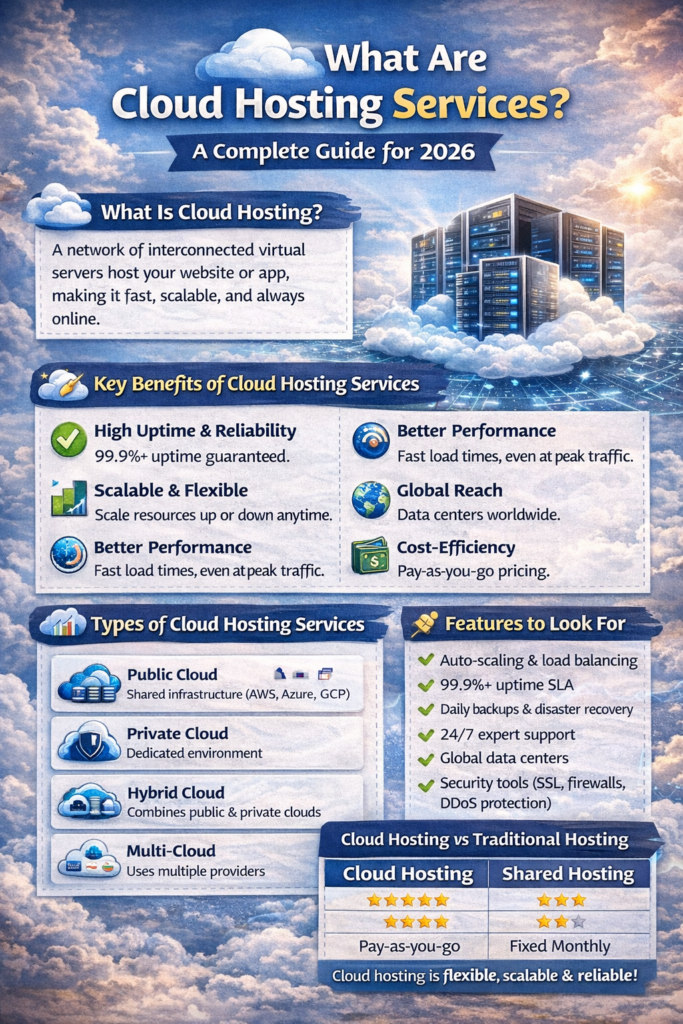
🌟 What Is Cloud Hosting?
Cloud hosting uses a network of connected servers (the “cloud”) to host websites and applications.
Instead of relying on a single physical server, your site runs on multiple virtual machines that share resources like storage, CPU, and memory.
This means your website can stay online, fast, and secure, even when traffic spikes or hardware fails.
🚀 Key Benefits of Cloud Hosting Services
Here’s why cloud hosting has become so popular:
✅ High Uptime & Reliability
Cloud hosting avoids single points of failure — if one server goes down, another instantly takes over.
✅ Scalability on Demand
Need more power during peak times? Cloud hosting lets you scale resources instantly without downtime.
✅ Better Performance
Because resources come from multiple machines, your site can stay fast — even under heavy load.
✅ Affordable Pay-As-You-Use Pricing
Instead of paying for unused resources, you only pay for what you actually use — like storage or bandwidth.
✅ Global Reach
Cloud services often have data centers around the world, so you can deliver content closer to your users.
✅ Strong Security
Leading cloud providers include built-in protections like firewalls, encryption, and automated backups.
📌 Who Should Use Cloud Hosting?
Cloud hosting is a great fit for:
✔ High-traffic blogs and business sites
✔ eCommerce stores with fluctuating demand
✔ Mobile and web applications
✔ SaaS and tech startups
✔ Digital agencies hosting multiple client sites
✔ Projects that need scalable, resilient infrastructure
⚙️ Types of Cloud Hosting Services
There are several options depending on your needs:
🌐 Public Cloud Hosted on shared virtual infrastructure (e.g., AWS, Google Cloud, Azure) — cost-effective and highly scalable.
🔒 Private Cloud Dedicated cloud space just for your organization — higher security and customization.
☁️ Hybrid Cloud Combines public and private clouds to balance security and cost-efficiency.
📍 Multi-Cloud Uses more than one cloud provider to optimize performance and avoid vendor lock-in.
🛠 Features to Look For
When choosing a cloud hosting provider, consider:
📌 Auto-scaling & load balancing
📌 99.9%+ uptime SLA
📌 Daily backups & disaster recovery
📌 24/7 support
📌 Global data centers
📌 Security tools (SSL, firewalls, DDoS protection)
💡 Cloud Hosting vs Traditional Hosting
| Feature | Cloud Hosting | Shared Hosting |
|---|---|---|
| Uptime | ⭐⭐⭐⭐ | ⭐⭐ |
| Scalability | ⭐⭐⭐⭐⭐ | ⭐ |
| Security | ⭐⭐⭐⭐ | ⭐⭐ |
| Performance | ⭐⭐⭐⭐ | ⭐⭐ |
| Pricing | Pay-as-you-go | Fixed monthly |
Cloud hosting wins when you need flexibility, power, and reliability.
🏁 Final Thoughts
Cloud hosting services are fast becoming the standard for websites and apps that demand high performance, scalability, and professional reliability.
Whether you’re a small business owner or a tech startup, switching to the cloud can future-proof your online presence and help you grow without limits.